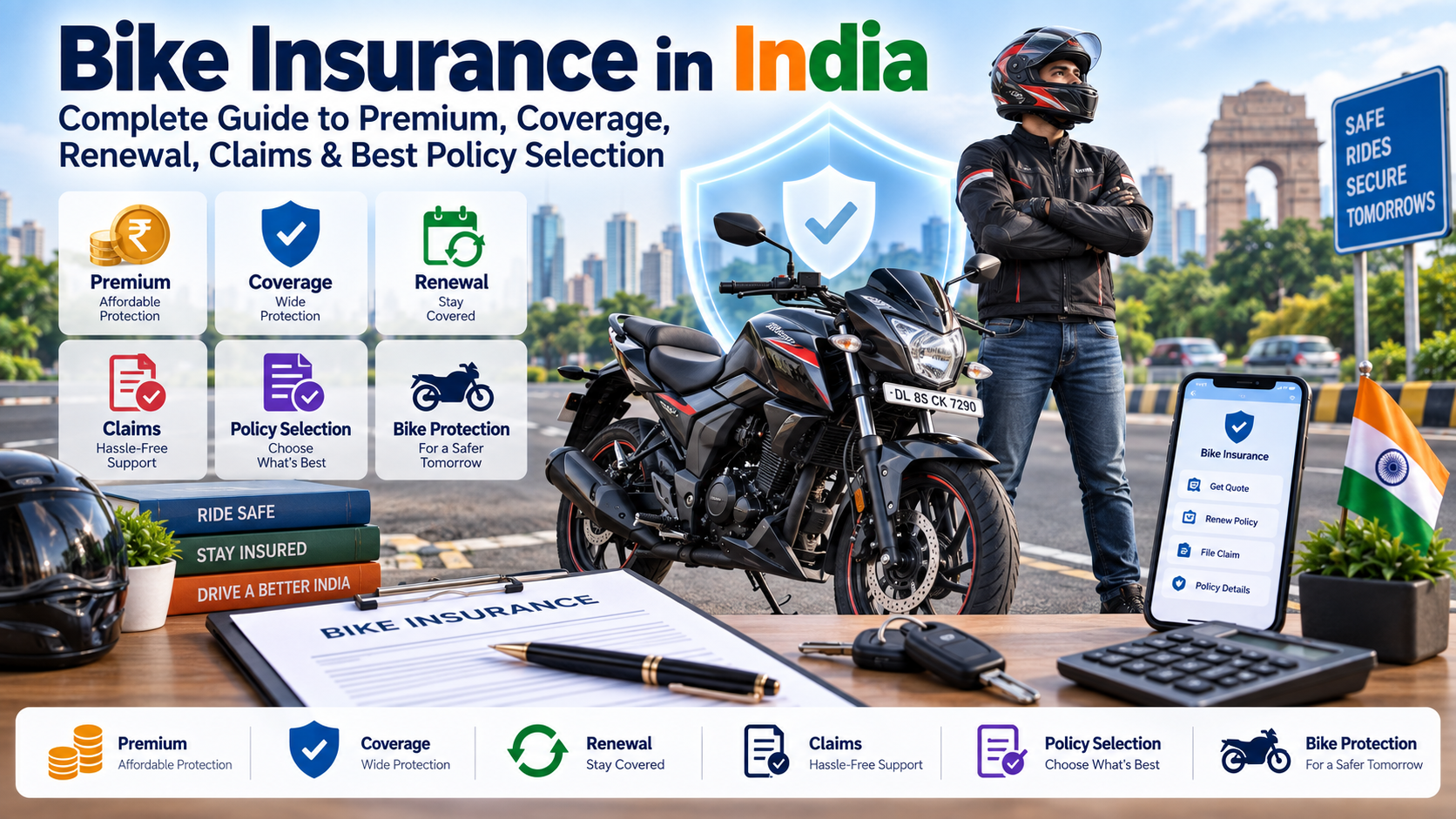
Two-wheelers represent the lifeblood of Indian personal mobility. With over 250 million motorcycles and scooters plying Indian roads, two-wheelers account for more than 70% of the country’s total vehicular population. However, their agility and prevalence come with heightened vulnerability. Two-wheeler riders face elevated risks of road accidents, traffic congestion, poor road surfaces, monsoon hazards, and vehicle theft across both metropolitan centers and rural heartlands.
In India, insuring your two-wheeler is not merely a sensible financial safeguard—it is a strict statutory requirement. Under the Motor Vehicles Act, 1988, operating an uninsured motorcycle or scooter on a public road is a punishable offense carrying steep monetary penalties and potential imprisonment.
Beyond legal compliance, an optimal bike insurance policy shields your savings against devastating financial shocks. From severe collision repairs and replacement of expensive fiber parts to total vehicular theft and catastrophic third-party liabilities, insurance transfers these burdens from your wallet to the insurance provider.
Recent regulatory interventions by the Insurance Regulatory and Development Authority of India (IRDAI)—specifically the consolidated Master Circular on General Insurance Business (June 2024)—have significantly strengthened policyholder rights:
- Automated Surveyor Allocation: For motor claims above ₹50,000, insurers must utilize an automated, tech-driven allocation process managed independently by the General Insurance Council to assign surveyors randomly, preventing biased assessments.
- Strict 7-Day Settlement Windows: Insurers are mandated to make a claim settlement decision within 7 days of receiving the surveyor’s final report.
- Prohibition of Document-Based Rejections: Claims cannot be rejected solely for missing documents that could have been obtained during customer onboarding.
- Pay-As-You-Drive Options: Insurers must offer usage-based and telematics-linked insurance products to benefit low-mileage riders.
Whether you are purchasing a brand-new motorcycle, insuring an electric scooter, or renewing an existing policy, this comprehensive guide provides the legal, financial, and practical knowledge required to make informed decisions.
Types of Bike Insurance Policies in India
The Indian general insurance market offers three core policy structures for two-wheelers. Choosing the most suitable coverage depends on your vehicle’s age, commercial value, usage intensity, and personal risk profile.
+-------------------------------------------------------------------------------------------------+
|                                 BIKE INSURANCE POLICY SPECTRUM                                  |
+-------------------------------------------------------------------------------------------------+
|                                                                                                 |
|   1. THIRD-PARTY ONLY (Mandatory)           2. STANDALONE OWN DAMAGE (OD)                       |
|   • Compulsory by Law (MVA Sec 146)         • Covers damage to your own two-wheeler             |
|   • Covers injury/death to third parties    • Natural & man-made disasters, fire, theft         |
|   • Covers third-party property up to ₹1L   • Requires active Third-Party policy                |
|   • ZERO payout for your own bike           • Allows custom add-ons (Zero Dep, RSA, NCB)        |
|                                                                                                 |
|                                3. COMPREHENSIVE BIKE INSURANCE                                  |
|                                • Complete Package: Own Damage + Third Party                     |
|                                • Total protection against accidents, theft, floods, riots       |
|                                • Compatible with Zero Dep, Engine Protect, RTI, etc.            |
|                                • Bundled with Compulsory Personal Accident (CPA) Cover          |
+-------------------------------------------------------------------------------------------------+
Comparative Breakdown of Policy Types
| Feature / Coverage Area | Third-Party (TP) Liability Cover | Standalone Own Damage (OD) Cover | Comprehensive Bike Insurance |
|---|---|---|---|
| Legal Mandate | Compulsory under Section 146, Motor Vehicles Act | Completely Optional | Third-Party section is mandatory; OD section is optional |
| Damage to Your Own Bike | Not Covered (₹0 compensation) | Fully Covered (Accident, Fire, Flood, Theft) | Fully Covered (Accident, Fire, Flood, Theft) |
| Third-Party Bodily Injury / Death | Unlimited financial liability determined by MACT | Not Covered (Must be active separately) | Unlimited financial liability determined by MACT |
| Third-Party Property Damage (TPPD) | Covered up to ₹1 Lakh (can be restricted to ₹6,000 for discount) | Not Covered | Covered up to ₹1 Lakh |
| Theft of Two-Wheeler | Not Covered | Covered up to Insured Declared Value (IDV) | Covered up to Insured Declared Value (IDV) |
| Add-On Rider Availability | Ineligible | Fully Eligible (Zero Dep, RSA, Consumables) | Fully Eligible for all Add-On Covers |
| No Claim Bonus (NCB) Eligibility | Not Applicable (Tariff fixed by IRDAI) | Applicable (20% to 50% discount on OD premium) | Applicable on the Own Damage premium portion |
| Best Suited For | Older two-wheelers (>7–10 years) with minimal market value | Bikes with active multi-year TP policies seeking standalone OD | New bikes, daily commuters, premium bikes, and EVs under 5–7 years |
Legal Framework: Motor Vehicles Act & Supreme Court Mandates
Driving an uninsured motorcycle or scooter on Indian public thoroughfares violates statutory national laws:
- Section 146 of the Motor Vehicles Act, 1988: Establishes that no individual shall drive or cause any other person to drive a motor vehicle in a public place unless an active insurance policy covering statutory third-party risks is in force.
- Penalties Under Section 196 (Amended 2019): Operating an uninsured two-wheeler invites a fine of ₹2,000 and/or imprisonment of up to 3 months for the first offense. For subsequent repeat offenses, the penalty escalates to ₹4,000 and/or imprisonment up to 3 months.
- Supreme Court 5-Year Mandate for New Two-Wheelers (September 2018): Under Supreme Court directions, all brand-new two-wheelers sold in India must carry a mandatory 5-year Third-Party insurance policy bundled at the time of purchase. Buyers typically select a “5-Year TP + 1-Year OD” bundled structure, renewing their Own Damage cover annually thereafter while retaining continuous five-year statutory third-party cover.
- Compulsory Personal Accident (CPA) Cover for Owner-Driver: Under General Regulation 36 (GR-36) of the Indian Motor Tariff, individual registered vehicle owners holding a valid permanent driving license must hold a ₹15 Lakh Compulsory Personal Accident cover (costing approximately ₹275 to ₹350 plus GST annually). If you already hold an active standalone 24-hour Personal Accident policy covering accidental death and permanent disability for ₹15 Lakh or more, or hold CPA cover under another insured vehicle, you can legally opt out.
Insured Declared Value (IDV): How Your Bike’s Value is Calculated
In vehicle insurance, your two-wheeler is not insured for a random sum assured. Instead, compensation operates strictly on the Insured Declared Value (IDV).
Under General Regulation 8 (GR-8) of the India Motor Tariff, the IDV is the maximum sum insured payable by the insurance company in the event of Total Loss (TL), Constructive Total Loss (CTL), or Vehicular Theft. A vehicle is legally deemed a Constructive Total Loss when the aggregate estimated cost of retrieval and repair exceeds 75% of the policy IDV.
The Standard IDV Calculation Formula
Registration charges, municipal road taxes, and policy insurance premiums are excluded from standard IDV computation.
Statutory Age-Wise Depreciation Schedule (India Motor Tariff GR-8)
| Age of the Two-Wheeler | Percentage of Depreciation Applied for IDV | Residual IDV (% of Ex-Showroom Price) |
|---|---|---|
| Up to 6 months | 5% | 95% |
| Exceeding 6 months but not exceeding 1 year | 15% | 85% |
| Exceeding 1 year but not exceeding 2 years | 20% | 80% |
| Exceeding 2 years but not exceeding 3 years | 30% | 70% |
| Exceeding 3 years but not exceeding 4 years | 40% | 60% |
| Exceeding 4 years but not exceeding 5 years | 50% | 50% |
| Exceeding 5 years of age | Determined by mutual agreement between insurer and vehicle owner | Based on market value / physical surveyor evaluation |
Hypothetical Example:
An Indian commuter, Rohan, purchases a commuter motorcycle with an ex-showroom price of ₹1,00,000.
- Year 1 (At Purchase): With 5% initial statutory depreciation, the IDV is set at:
₹1,00,000−5%=₹95,000- Year 2 (Renewal at 14 months): Depreciation increases to 20%. The renewed policy IDV becomes:
₹1,00,000−20%=₹80,000- If Rohan’s bike is stolen in Year 2 and remains untraced by police, the insurer settles the total loss claim at the agreed IDV of ₹80,000 (minus the nominal ₹100 compulsory policy deductible).
Two-Wheeler Insurance Premium: Pricing Components & Formula
A comprehensive bike insurance premium is computed using distinct statutory and commercial components:
+-------------------------------------------------------------------------------------------------+
|                                 BIKE INSURANCE PREMIUM FORMULA                                  |
+-------------------------------------------------------------------------------------------------+
|                                                                                                 |
|   +-----------------------------------------------------------------------------------------+   |
|   | 1. Own Damage (OD) Rate      : Based on IDV, Engine CC / Electric kW, Make, Age & Zone  |   |
|   | Less: No Claim Bonus (NCB)   : 20% to 50% discount on OD section                        |   |
|   | Less: Anti-Theft Discount    : ARAI-approved device discount (2.5% up to ₹500)          |   |
|   +-----------------------------------------------------------------------------------------+   |
|                                              +                                                  |
|   +-----------------------------------------------------------------------------------------+   |
|   | 2. Third-Party (TP) Tariff   : Fixed by IRDAI/MoRTH based on Engine Displacement        |   |
|   |    • Up to 75 cc             • 75 cc to 150 cc       • 150 cc to 350 cc                 |   |
|   |    • Exceeding 350 cc        • Electric Two-Wheelers (kW-based discounted slabs)        |   |
|   +-----------------------------------------------------------------------------------------+   |
|                                              +                                                  |
|   +-----------------------------------------------------------------------------------------+   |
|   | 3. Add-On Rider Premiums     : Zero Dep, Engine Protect, RSA, Consumables, RTI          |   |
|   | 4. Compulsory PA (CPA) Cover : ₹15 Lakh cover for Owner-Driver (~₹275 to ₹350)          |   |
|   +-----------------------------------------------------------------------------------------+   |
|                                              +                                                  |
|   +-----------------------------------------------------------------------------------------+   |
|   | 5. Statutory Taxes           : Goods and Services Tax (GST) at 18%                      |   |
|   +-----------------------------------------------------------------------------------------+   |
+-------------------------------------------------------------------------------------------------+
Statutory Third-Party Premium Slabs (Annual Rates)
Third-Party premium rates are strictly regulated by the central government and IRDAI based on engine displacement (Cubic Capacity) and propulsion type:
| Vehicle Classification (Internal Combustion Engines) | Indicative Annual Statutory TP Premium (₹)* | Electric Two-Wheelers (Electric Motor Capacity) | Indicative Annual Statutory TP Premium (₹)* |
|---|---|---|---|
| Not exceeding 75 cc | ₹538 | Not exceeding 3 kW | ₹457 |
| Exceeding 75 cc but not exceeding 150 cc | ₹714 | Exceeding 3 kW but not exceeding 7 kW | ₹607 |
| Exceeding 150 cc but not exceeding 350 cc | ₹1,366 | Exceeding 7 kW but not exceeding 16 kW | ₹1,161 |
| Exceeding 350 cc (Superbikes / Cruisers) | ₹2,804 | Exceeding 16 kW | ₹2,383 |
*Note: Rates exclude applicable 18% GST. Statutory TP tariffs are periodically revised by official notifications from the Ministry of Road Transport and Highways (MoRTH) in consultation with IRDAI.
Key Factors Affecting Your Own Damage Premium
- Engine Displacement / Motor Output: Higher engine capacity (CC) or electric motor wattage increases the base Own Damage rate due to higher repair costs and risk velocity.
- Geographical Registration Zone: India is divided into two rating zones:
- Zone A (Higher tariffs): Ahmedabad, Bengaluru, Chennai, Delhi, Hyderabad, Kolkata, Mumbai, and Pune.
- Zone B (Lower tariffs): All other regions and cities across India.
- Vehicle Age & IDV: As your motorcycle ages, IDV drops, progressively reducing the Own Damage premium.
- ARAI Anti-Theft Devices: Installing an Automotive Research Association of India (ARAI) approved anti-theft locking device earns an upfront discount of 2.5% on the base OD premium (up to ₹500).
No Claim Bonus (NCB): Slabs and the 90-Day Renewal Rule
The No Claim Bonus (NCB) is a substantial reward offered to bike owners who do not register any insurance claims during a policy year:
- NCB Belongs to the Rider, Not the Motorcycle: NCB is an underwriting benefit earned by you as an individual, not by the machine. If you sell your motorcycle, you can preserve your accumulated NCB certificate and transfer the discount to a newly purchased two-wheeler.
- Applies Strictly to the Own Damage Component: NCB applies solely to the Own Damage premium; it does not discount the mandatory Third-Party statutory rate.
Standard NCB Progression Grid
| Claim-Free Track Record | Accrued NCB Discount on OD Premium |
|---|---|
| After 1 claim-free year | 20% |
| After 2 consecutive claim-free years | 25% |
| After 3 consecutive claim-free years | 35% |
| After 4 consecutive claim-free years | 45% |
| After 5 consecutive claim-free years (Maximum Cap) | 50% |
Critical Regulatory Rule: The 90-Day Grace Window:
If you fail to renew your expired bike insurance policy within 90 days of its expiry date, your entire accrued No Claim Bonus resets to 0%. Renewing before the 90-day threshold preserves your hard-earned discount even if the policy has briefly lapsed.
Essential Bike Insurance Add-On Covers
Standard two-wheeler policies enforce steep statutory material depreciation on replaced parts during accident repairs. Add-on riders eliminate these substantial out-of-pocket costs.
+-------------------------------------------------------------------------------------------------+
|                                POPULAR BIKE INSURANCE ADD-ONS                                   |
+-------------------------------------------------------------------------------------------------+
|                                                                                                 |
|   +---------------------------+  Eliminates 50% statutory depreciation on plastic, rubber, fiber|
|   | Zero Depreciation Cover   |  components (fairings, mudguards, mirrors). Essential for bikes.|
|   +---------------------------+                                                                 |
|                                                                                                 |
|   +---------------------------+  Covers water ingress (hydrostatic lock) and engine oil leakage|
|   | Engine Protection Cover   |  damage to engine blocks and gearboxes during monsoon flooding. |
|   +---------------------------+                                                                 |
|                                                                                                 |
|   +---------------------------+  Bridges the gap between depreciated IDV and original ex-factory|
|   | Return to Invoice (RTI)   |  purchase invoice price (including road tax and RTO charges).   |
|   +---------------------------+                                                                 |
|                                                                                                 |
|   +---------------------------+  Provides 24x7 roadside towing, flat-tire assistance, on-site  |
|   | Roadside Assistance (RSA) |  puncture repair, fuel delivery, and jump-starts when stranded. |
|   +---------------------------+                                                                 |
|                                                                                                 |
|   +---------------------------+  Pays for non-reusable workshop items like engine oil, washers, |
|   | Consumables Cover         |  grease, brake fluids, nuts, and bolts excluded in base plans.  |
|   +---------------------------+                                                                 |
|                                                                                                 |
|   +---------------------------+  Dedicated cover for high-voltage traction batteries, drive    |
|   | EV Battery & Charger Cover|  motors, and home charging cables against water surge and fires.|
|   +---------------------------+                                                                 |
+-------------------------------------------------------------------------------------------------+
1. Zero Depreciation (“Zero Dep” / Bumper-to-Bumper)
Modern motorcycles and scooters are built with extensive plastic fairings, fiber cowls, rubber gaskets, and delicate headlamp assemblies. Under standard policies, insurers deduct 50% depreciation on all plastic and rubber parts, 30% on fiberglass, and tiered rates on metal. A Zero Depreciation cover removes this deduction, ensuring the insurer pays 100% of the replacement parts cost (subject only to the standard compulsory deductible). Highly recommended for vehicles up to 5 years old.
2. Engine and Gearbox Protection Cover
Standard motor insurance treats water ingress as consequential damage. If a rider drives through a waterlogged road and water is sucked into the engine—causing the piston or connecting rod to seize (hydrostatic lock)—repairs are excluded in standard policies. An Engine Protection rider covers the repair or complete replacement of internal engine parts, pistons, crankcases, and cylinder heads damaged by waterlogging or lubricant leakage.
3. Roadside Assistance (RSA) Cover
Two-wheelers are vulnerable to highway punctures and mechanical breakdowns. An RSA rider provides emergency assistance 24 hours a day, 365 days a year:
- Flat-tire assistance and on-site minor repairs.
- Emergency fuel delivery (up to 2–5 liters, fuel billed at actuals).
- Towing to the nearest authorized network garage in the event of major mechanical failure or accident.
- Battery jump-starting.
4. Return to Invoice (RTI)
If your two-wheeler is stolen or destroyed in an accident resulting in a constructive total loss, a standard policy pays only the depreciated IDV. Return to Invoice covers the entire gap between your policy IDV and the vehicle’s original ex-showroom purchase price, including municipal road tax and initial registration fees paid to the RTO.
5. Consumables Cover
During repair work, workshops replace consumable items such as engine oil, gear lubricant, fork oil, grease, brake oil, washers, clips, and nuts. Standard policies exclude these costs. A Consumables rider reimburses these cumulative workshop charges.
Electric Bike (EV) Insurance: Key Considerations
With the rapid adoption of electric two-wheelers (such as Ather, Ola, TVS iQube, and Bajaj Chetan) across India, insuring an EV requires attention to components not found in internal combustion engine (ICE) vehicles:
- Traction Battery Replacement: The lithium-ion battery pack represents 30% to 50% of an electric scooter’s total value. Standard policies cover accidental battery damage, but exclude internal short-circuits, thermal runaways, or water damage caused by water ingress beyond rated IP certifications unless an EV Battery Protector add-on is held.
- Charging Equipment Coverage: Portable domestic chargers and wall-box adapters kept at home are vulnerable to electrical power surges, fires, and accidental breakage. Leading insurers now provide specific add-on riders covering home charging accessories.
- Discounted Statutory TP Tariffs: To incentivize green mobility, MoRTH and IRDAI provide an approximate 15% statutory discount on Third-Party premium rates for electric two-wheelers compared to equivalent fossil-fuel vehicles.
What is Not Covered? (Bike Insurance Exclusions)
Understanding policy exclusions prevents unexpected claim repudiations:
- Driving Without a Valid Driving License: If the individual riding the bike at the time of an accident lacks a valid, effective driving license, or holds a learner’s permit without adhering to legal accompaniment rules, the claim is rejected.
- Riding Under the Influence: Any accident occurring while the rider is intoxicated with alcohol, drugs, or illegal psychotropic substances completely voids coverage.
- Consequential Losses: Mechanical damage resulting from the rider’s continued operation after an accident. For example, running the motorcycle after an accident has cracked the oil pan, causing total engine seizure, is considered consequential damage and excluded from base coverage.
- Regular Wear, Tear, and Aging: Normal mechanical wear, tire punctures, peeling paint, rust, and mechanical or electrical failures are excluded.
- Riding Without a Helmet: While failure to wear an approved helmet does not automatically void vehicular damage claims, it directly jeopardizes personal accident claims resulting from fatal head trauma under contributory negligence principles.
- Commercial Use of Private Vehicles: Using a private white-plate two-wheeler for commercial courier, grocery delivery, or passenger ride-hailing services without a commercial vehicle permit and insurance endorsement results in immediate claim rejection.
- Speed Contests and Stunts: Damage arising from speed trials, street racing, rallies, or unapproved stunt performances is strictly excluded.
Deductibles in Bike Insurance: Compulsory vs Voluntary
A deductible is the predetermined amount of an approved repair bill that the policyholder must pay out of pocket before insurance coverage takes effect.
+-------------------------------------------------------------------------------------------------+
|                                 DEDUCTIBLE STRUCTURE IN CLAIMS                                  |
+-------------------------------------------------------------------------------------------------+
|                                                                                                 |
|   [ Total Approved Two-Wheeler Repair Bill: ₹8,000 ]                                            |
|                                                                                                 |
|   1. Compulsory Deductible (Mandated by Tariff) : ₹100 (Standard for all two-wheelers)          |
|   2. Voluntary Deductible (Chosen by rider)     : ₹1,000 (Selected to lower annual premium)     |
|   ───────────────────────────────────────────────────────────────────────────────────────────   |
|   Total Policyholder Deductible Out-of-Pocket   : ₹1,100                                        |
|   Insurer Claim Settlement Balance              : ₹6,900 (Subject to depreciation / add-ons)    |
+-------------------------------------------------------------------------------------------------+
- Compulsory Deductible: Under the India Motor Tariff, a statutory excess of ₹100 is deducted from every admissible Own Damage claim filed for a two-wheeler. This is fixed by regulation and cannot be waived.
- Voluntary Deductible: An additional excess amount (such as ₹500, ₹1,000, or ₹2,500) that you voluntarily agree to bear per claim. Opting for a higher voluntary deductible lowers your annual Own Damage premium, but requires you to pay that chosen amount out of pocket during repairs.
Step-by-Step Two-Wheeler Insurance Claim Process
When an accident, monsoon flood, or vehicular theft occurs, follow these procedures to ensure prompt claim processing.
+-------------------------------------------------------------------------------------------------+
|                                   BIKE INSURANCE CLAIM PATHS                                    |
+-------------------------------------------------------------------------------------------------+
|                                                                                                 |
|   [ CASHLESS CLAIM AT NETWORK WORKSHOP ]               [ REIMBURSEMENT AT NON-NETWORK GARAGE ]  |
|                                                                                                 |
|   Step 1: Intimate Insurer Immediately                 Step 1: Intimate Insurer Immediately     |
|           (Toll-Free, Mobile App, or Web)                      (Before starting any repairs)    |
|                         │                                                       │               |
|                         ▼                                                       ▼               |
|   Step 2: Move Bike to Network Garage                  Step 2: Surveyor Inspection at Garage    |
|           • Digital / Video Self-Inspection                    • Physical survey & loss report  |
|           • Independent Surveyor allocated                     • Approval given before work     |
|                         │                                                       │               |
|                         ▼                                                       ▼               |
|   Step 3: Workshop Completes Repairs                   Step 3: Pay Repair Bills Directly        |
|           • Genuine parts replaced                             • Settle all workshop bills      |
|           • Zero Dep covers fiber/plastic                      • Collect stamped tax invoices   |
|                         │                                                       │               |
|                         ▼                                                       ▼               |
|   Step 4: Delivery & Settlement                        Step 4: Submit Reimbursement Dossier     |
|           • Rider pays only ₹100 deductible                    • Insurer reviews submitted bills|
|           • Insurer settles garage bill directly               • NEFT credit within 7-15 days   |
+-------------------------------------------------------------------------------------------------+
1. Cashless Bike Insurance Claim Workflow
- Immediate Claim Intimation: Contact the insurer within 24 to 48 hours via their mobile app, portal, or toll-free telephone line. Provide the policy number, time, location, and a brief description of the incident.
- Move Vehicle to a Network Garage: Tow or ride the motorcycle to an authorized network workshop. Do not authorize repairs before the surveyor conducts the initial inspection.
- Survey and Damage Assessment: Minor claims (up to ₹20,000–₹30,000) are commonly inspected via the insurer’s digital self-inspection mobile app (live video or photo upload). For major losses over ₹50,000, an independent surveyor is allocated automatically under IRDAI guidelines.
- Repair Approval and Delivery: Once the survey assessment is approved, the garage completes the repairs. Under the IRDAI Master Circular (2024), insurers must convey final settlement decisions within 7 days of receiving the survey report. You pay only the ₹100 compulsory deductible and non-covered consumables; the insurer settles the remaining bill directly with the garage.
2. Two-Wheeler Theft Claim Workflow
Because two-wheelers are physically easier to steal than cars, theft claims are frequent:
- File an Immediate Police FIR: Lodge an official First Information Report (FIR) under Section 379 of the Indian Penal Code (or relevant Bharatiya Nyaya Sanhita provision) at the police station holding jurisdiction over the theft site.
- Notify Insurer and Local RTO: Inform your insurance provider in writing and submit a formal theft notification to the Regional Transport Office (RTO) where the bike is registered.
- Secure the Police “Untraced Report”: If the police are unable to recover the stolen bike after their investigation, the jurisdictional magistrate court issues a “Non-Traceable Certificate” (Untraced Report).
- Claim Settlement: Submit the original FIR, court untraced report, original registration certificate (RC Book), both sets of original keys, signed RTO transfer forms (Forms 28, 29, and 30), and an indemnity bond. The insurer then deposits the full policy IDV directly into your bank account via NEFT.
Two-Wheeler Insurance Renewal and Ownership Transfer
Renewal Best Practices
- Avoid Coverage Lapses: Driving an expired bike leaves you vulnerable to ₹2,000/₹4,000 traffic fines and unpayable third-party compensation liabilities if an accident occurs during the lapse.
- Keep the 90-Day NCB Window in Mind: If your policy lapses, renew within 90 days of the expiry date to ensure your accumulated 20% to 50% No Claim Bonus is not permanently forfeited.
- Digital Self-Inspection for Lapsed Policies: If a policy has expired beyond the renewal date, most insurers allow instant policy reactivation by uploading a 360-degree video or photos of the motorcycle via their mobile app without needing an in-person physical survey.
Transferring Insurance When Buying a Pre-Owned Bike
When purchasing or selling a used motorcycle or scooter in India:
- Under Section 157 of the Motor Vehicles Act, the statutory Third-Party policy transfers automatically to the new owner upon legal vehicular transfer.
- However, the Own Damage portion must be formally transferred within 14 days of the RTO ownership transfer by submitting the updated Registration Certificate (RC), sale deed, transfer fee, and a new proposal form.
- Transferring the NCB: The seller retains their accumulated No Claim Bonus by requesting an NCB Retention Certificate from the insurer, which can be applied to reduce premiums on their next two-wheeler purchase. The buyer pays the pro-rata difference on the remaining policy premium.
10 Common Mistakes to Avoid When Buying Bike Insurance
- Purchasing Only Third-Party Cover for New Bikes: While Third-Party insurance fulfills legal compliance, it pays ₹0 if your bike is damaged in an accident, burnt in a fire, or stolen. New and premium bikes should always have Comprehensive coverage.
- Skipping Zero Depreciation on Commuter and Sports Bikes: Because motorcycles feature extensive fiber and plastic bodywork, standard policies deduct a 50% depreciation charge on replacement parts during repairs. Skipping Zero Dep results in substantial out-of-pocket expenses for minor repairs.
- Deflating the IDV to Lower Premiums: Artificially lowering your motorcycle’s IDV reduces the annual premium by a few hundred rupees, but drastically lowers your insurance payout if the bike is stolen or damaged beyond repair.
- Letting the Policy Lapse Beyond 90 Days: Allowing an expired policy to sit past 90 days completely resets your accumulated No Claim Bonus (worth up to a 50% discount) to zero.
- Ignoring the ₹15 Lakh Compulsory Personal Accident (CPA) Cover: Failing to maintain an active CPA cover leaves the owner-driver unprotected against accidental death or permanent disability and risks traffic penalties during road checks.
- Filing Small Claims for Minor Cosmetic Damage: Registering a ₹1,000 claim for a minor mirror or mudguard repair wipes out a 35% or 50% NCB discount that would have saved you more on renewal premiums.
- Neglecting to Endorse Electrical or Performance Accessories: Adding expensive aftermarket headlights, performance exhausts, or custom luggage racks without endorsing them on your policy leaves those accessories uninsured.
- Using Private Two-Wheelers for Commercial Delivery: Using a private white-plate motorcycle for commercial food or parcel delivery without commercial endorsement gives insurers legal grounds to repudiate claims.
- Repairing the Vehicle Before Official Survey: Transporting a damaged bike to a local workshop and starting disassembly before the insurer conducts a digital or physical survey can lead to claim rejection.
- Riding with an Invalid or Expired Driving License: Any accident occurring while the rider lacks a valid driving license renders all Own Damage and liability claims invalid.
How to Compare and Select the Right Bike Insurance Policy
When comparing two-wheeler insurance policies online, evaluate insurers across these objective parameters:
+-------------------------------------------------------------------------------------------------+
|                                 BIKE INSURANCE SELECTION MATRIX                                 |
+-------------------------------------------------------------------------------------------------+
|                                                                                                 |
|   Evaluation Metric         | Poor / High Risk Standard       | Ideal / Recommended Standard    |
|   ──────────────────────────┼─────────────────────────────────┼─────────────────────────────    |
|   Incurred Claim Ratio (ICR)| Below 50% or Above 100%         | Balanced: 65% to 85%            |
|   Cashless Workshop Network | Small, localized workshop list  | 3,000+ pan-India tie-up garages |
|   Digital Claim Processing  | Paper-heavy, physical surveys   | Instant App / Video inspections |
|   Claim Decision Speed      | Prolonged administrative delays | Within 7 days of survey report  |
|   Zero Dep Age Limit        | Restrictive (1–2 years only)    | Available for bikes up to 5 yrs |
|   IDV Valuation Accuracy    | Artificially suppressed value   | Aligned with standard IMT rates |
|                                                                                                 |
+-------------------------------------------------------------------------------------------------+
Key Questions to Ask Before Purchasing
- Does the quoted policy IDV reflect standard India Motor Tariff depreciation schedules, or was it reduced to make the premium look cheaper?
- Does the insurer maintain cashless tie-ups with authorized two-wheeler workshops in your local city or district?
- Does the policy offer instant digital self-inspection via a smartphone app for quick settlement of minor accident claims?
- Are fiber cowls, headlights, and mirrors covered at 100% through a Zero Depreciation rider?
- What is the insurer’s Incurred Claim Ratio (ICR) in the latest IRDAI Annual Report? (An ICR between 65% and 85% reflects balanced claim payouts and underwriting stability).
Frequently Asked Questions (FAQs)
1. Is two-wheeler insurance mandatory in India?
Yes. Under Section 146 of the Motor Vehicles Act, 1988, every two-wheeler driven on Indian public roads must have at least an active Third-Party Liability insurance policy. Driving an uninsured two-wheeler carries a fine of ₹2,000 and/or up to 3 months imprisonment for the first offense, and ₹4,000 and/or up to 3 months imprisonment for repeat offenses under Section 196.
2. What is the difference between Third-Party and Comprehensive bike insurance?
Third-Party insurance covers only legal liabilities for injury, death, or property damage caused to third parties; it provides zero financial payout for damage to your own bike. Comprehensive insurance covers third-party liabilities as well as Own Damage to your two-wheeler resulting from accidents, fire, theft, and natural catastrophes.
3. Why is 5-year Third-Party insurance mandatory for brand-new bikes?
Under a 2018 Supreme Court ruling, all brand-new two-wheelers sold in India must carry a mandatory 5-year Third-Party insurance policy to ensure sustained third-party liability coverage and protect road accident victims. Buyers typically purchase a bundled policy (“5-Year TP + 1-Year OD”) and renew the Own Damage section annually.
4. What is Insured Declared Value (IDV) in bike insurance?
IDV is the maximum sum insured payable by the insurer if your motorcycle or scooter is stolen or damaged beyond repair (Constructive Total Loss). It is calculated based on the manufacturer’s listed ex-showroom price minus statutory age-wise depreciation defined under the India Motor Tariff.
5. What is Zero Depreciation cover in two-wheeler insurance?
Zero Depreciation (bumper-to-bumper) is an add-on rider that eliminates the standard 50% depreciation deduction on plastic, fiber, and rubber parts during accident repairs. With Zero Dep, the insurer covers the full replacement cost of approved parts.
6. Can I transfer my No Claim Bonus (NCB) when buying a new bike?
Yes. The No Claim Bonus belongs to you as the policyholder, not the machine. When selling your old bike, you can obtain an NCB Retention Certificate from your insurer and apply your 20% to 50% discount to reduce the Own Damage premium on your new two-wheeler.
7. What happens if my bike insurance expires?
If your policy expires, your vehicle is uninsured. Riding it risks police fines and personal liability for accident damages. Additionally, if you fail to renew within 90 days of policy expiry, your entire accrued No Claim Bonus is forfeited.
8. What is the Compulsory Personal Accident (CPA) cover for owner-drivers?
Under General Regulation 36 of the Indian Motor Tariff, registered individual vehicle owners must hold a ₹15 Lakh Personal Accident cover to protect against accidental death or permanent total disability. You can opt out if you already hold an active standalone personal accident policy of ₹15 Lakh or more.
9. What is the compulsory deductible for two-wheelers?
Under the India Motor Tariff, the compulsory deductible for all two-wheelers is ₹100 per claim. This nominal amount is deducted from every admissible Own Damage claim payment.
10. Does bike insurance cover electric scooters and electric motorcycles?
Yes. Electric two-wheelers require mandatory insurance. Insurers offer specialized policies covering traction batteries, electric drive motors, and home charging accessories, alongside statutory Third-Party cover which carries an approximate 15% discount compared to petrol-driven bikes.
11. Can I renew a lapsed bike insurance policy online without physical inspection?
Yes. Most Indian insurers allow instant online renewal of lapsed policies through digital self-inspection. You photograph or record a continuous 360-degree video of the two-wheeler using the insurer’s smartphone app, eliminating the need for an in-person physical survey.
12. Are bike insurance premiums tax-deductible in India?
For salaried individuals using a two-wheeler for personal commuting, bike insurance premiums are not eligible for income tax deductions. However, self-employed individuals, freelance professionals, and registered businesses using two-wheelers for business operations can deduct insurance premiums and repair expenses as legitimate business expenses under the Income Tax Act, 1961.
13. What documents are needed to file a cashless bike insurance claim?
Key documents include a completed claim form, copy of the valid insurance policy certificate, vehicle Registration Certificate (RC), the rider’s valid driving license, repair estimates from the network garage, and a police FIR (mandatory in cases of theft, major collision, or third-party injury).
14. What should I do if my two-wheeler is stolen?
Immediately file a First Information Report (FIR) at the local police station, submit written notifications to your insurance company and the RTO, and obtain a court-endorsed “Untraced Report” if the police fail to recover the bike. Submit these records along with both original keys and RTO transfer forms to receive your full policy IDV payout.
Sources & References
- Ministry of Road Transport and Highways (MoRTH), Government of India: The Motor Vehicles Act, 1988 (Sections 146, 147, 157, and 196 as amended by the Motor Vehicles Amendment Act, 2019). https://morth.nic.in
- Insurance Regulatory and Development Authority of India (IRDAI): Master Circular on General Insurance Business (Operations and Products), Ref: IRDAI/NL/CIR/MISC/2024, June 11, 2024. https://irdai.gov.in
- Supreme Court of India: Writ Petition (Civil) No. 434 of 2012; Order on Mandatory Long-Term Third-Party Insurance for Two-Wheelers and Four-Wheelers, July 20, 2018. https://main.sci.gov.in
- General Insurance Council of India (GIC): India Motor Tariff Regulations (General Regulations GR-8 for IDV, GR-27 for NCB, and GR-36 for CPA Cover). https://www.gicouncil.in
- Ministry of Road Transport and Highways (MoRTH), Government of India: Notification on Motor Vehicle Third Party Premium Rates for Two-Wheelers and Electric Vehicles, Gazette Notification. https://pib.gov.in
- Office of the Insurance Ombudsman (Council for Insurance Ombudsmen): Grievance Handling Procedures for Motor Vehicle Claim Disputes. https://www.cioins.co.in